
$121,000 in FISP Penalties: What NYC Building Owners Can Learn From a Recent Court Decision
A Brooklyn condominium asked a New York court to declare $121,000 in Facade Inspection Safety Program (FISP) civil penalties waived and uncollectible. The penalties arose from its failure to provide a required facade report. In April 2026, the court dismissed the case.
The court did not rule that FISP penalties can never be challenged or determine whether the City could ultimately collect the full amount. Instead, it found that because the City had not filed a collection action, there was no current dispute for the court to decide. The court also noted that the condominium had not filed the required report or used the DOB process available to contest the penalties. Read the April 2026 decision: Richardson Condominium v. City of New York.
For boards, owners, and managing agents, the lesson is straightforward: address open violations, complete required filings, and review challenge or waiver options promptly with a QEWI and legal counsel.
How to Address Active DOB FISP Violations
The appropriate response depends on the type of violation:
- Identify the violation. Determine whether the issue involves a missing or late initial report, uncorrected Unsafe conditions or a SWARMP condition from the previous cycle. Each requires a different response.
- File the correct report. A failure-to-file violation requires an acceptable initial FISP report. If a building is classified as Unsafe, the conditions must be corrected before a QEWI can submit an amended report reclassifying the property as Safe or SWARMP.
- Track extensions carefully. When Unsafe repairs cannot be completed within 90 days, a QEWI may request an extension from DOB. Extensions are subject to approval and cover only qualifying periods. They do not automatically remove penalties already incurred.
- Review challenge and waiver options. DOB rules provide procedures for challenging civil penalties and requesting waivers under certain circumstances. Owners should review these options promptly with legal counsel and their QEWI.
- Confirm DOB acceptance. Submitting a report does not complete the filing process. Track the report, respond to DOB objections and confirm that it has been accepted.
How to Reduce the Risk of FISP Penalties
- Start early in the filing window: Each FISP sub-cycle provides 24 months to file, which seems like a long time but keep in mind that planning access and scheduling the required close-up examinations can sometimes take many months, particularly for buildings requiring multiple drops or complex access. Demand typically increases during the final six months, when scheduling options can become more limited. Engaging a QEWI near the beginning of the window provides the most flexibility and leaves time to complete the inspections, prepare the report and address unexpected issues. Filing late can result in a $1,000 monthly penalty in addition to a $5,000 annual failure-to-file penalty. Inspection and filing dates should be coordinated with the QEWI because the report must be filed within 60 days of the final inspection and no more than one year after the close-up inspection.
- Address SWARMP conditions promptly: A SWARMP classification does not itself carry an immediate penalty. However, if a condition reported as SWARMP in the previous cycle remains uncorrected at the next inspection, it must be classified as Unsafe. A $2,000 civil penalty also applies when the condition is subsequently filed as Unsafe.
- Plan for required repairs: If a critical examination identifies Unsafe conditions, the owner must install appropriate public protection immediately and address the conditions within the required timeframe. Include potential facade repairs in capital planning so work can proceed without unnecessary delays.
- Keep required permits current: Monitor expiration dates for facade repair and sidewalk shed permits while work is underway. An expired sidewalk shed permit can result in separate violations and penalties.
How RAND Resolves DOB Facade Violations
Open FISP filings and penalties can become more difficult and costly to resolve over time.
RAND’s team of QEWIs, licensed engineers and architects, certified rope access professionals, and staff experienced in DOB facade filings can assist with:
- FISP Filing and Violation Reviews: Review DOB records, prior reports, and open violations to identify the property’s current status and outstanding requirements.
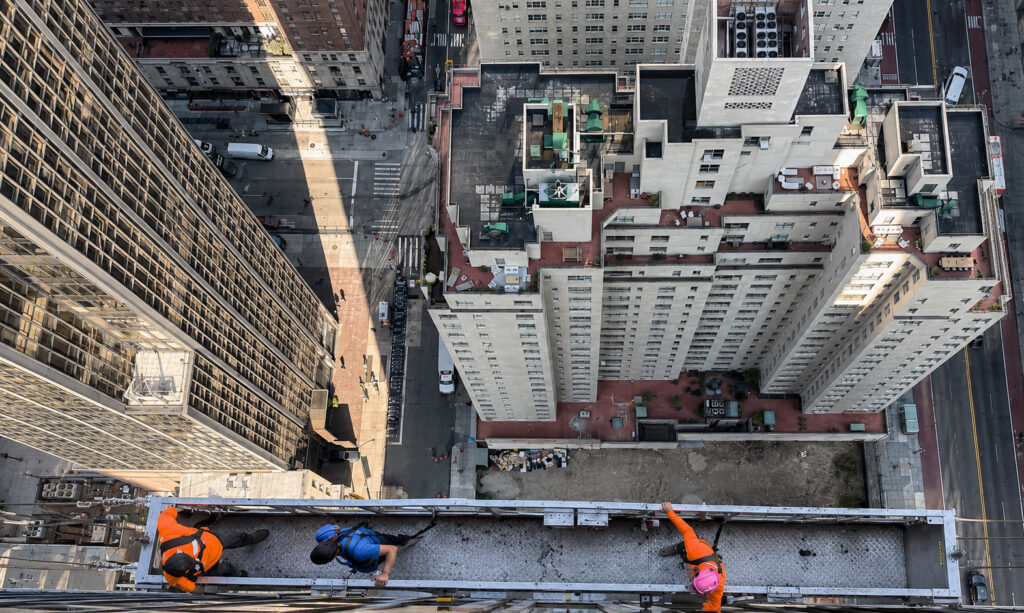
- Critical Examinations: Perform required hands-on inspections using rope access, swing stages, boom trucks, or other appropriate methods. Drone surveys can supplement inspections of complex facades but do not replace required hands-on examinations.
- FISP Reports and DOB Submissions: Prepare initial, amended, or subsequent FISP reports, submit extension requests when appropriate, and respond to DOB comments.
- Repair Program Design and Administration: Develop the repair scope, prepare drawings and specifications, assist with contractor bidding, and administer the work during construction.
The Richardson case shows how an unfiled FISP report can become a six-figure problem. If your property has an open filing, violation, or penalty, do not wait to investigate it. Missed filing, extension, or challenge deadlines can narrow the options available.
Need help addressing an open FISP violation or preparing for an upcoming deadline? Contact RAND at 212-675-8844 or info@randpc.com.
This article provides general information and is not legal advice. Building owners should consult legal counsel regarding penalty challenges, waiver requests, or litigation.