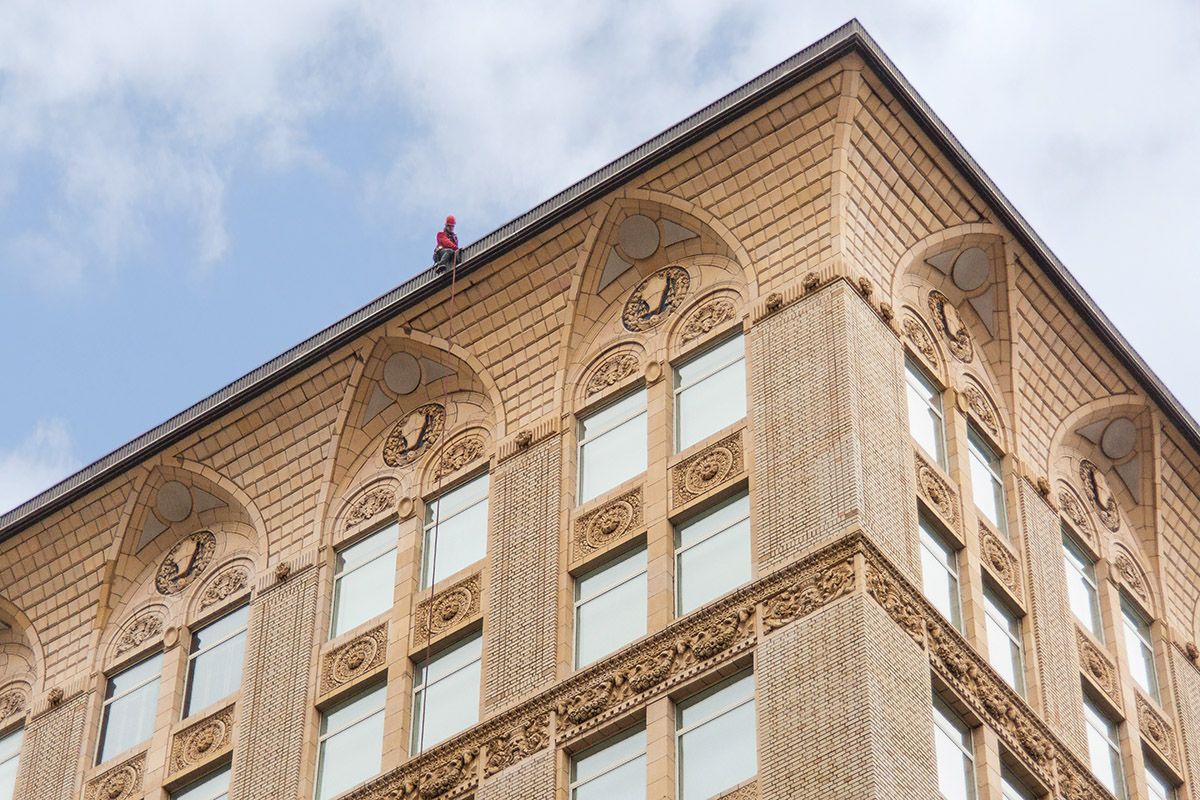

Finding Building Information Online

The amount of information an owner, agent, or engineer/architect may need to know about a building can be extensive. Fortunately a number of websites and online databases makes it much easier to find property data than it was just a few years ago.

For instance, to find a building's block and lot number you once had to leaf though pages and pages of the huge Sanborn Maps. Now that information and a lot more is just a click away.

One of the more popular online database is Buildings Information System, developed and maintained by the New York City Department of Buildings. At any given moment in Rand's office a staff member is likely checking BIS to gather information for one of our projects. Block and lot is just the tip of the proverbial iceberg in BIS. I check the site regularly to confirm the status of my projects' permit applications, previous Local Law 11/98 filings, and Certificates of Occupancy, among other things. The beauty of BIS is that it's public information available to anyone; you don't need to be an engineer or architect to use it. The website is not particularly intuitive, however, so if you're using it for the first time, check out the Frequently Asked Questions and the glossary.

Another database I find helpful is HPD Building Info, maintained by the New York City Department of Housing Preservation and Development. The site lists property owner and registration, open violations, complaints, charges and fees, pending litigation, and lots of other information.

NYC OASIS is an interactive map that offers a wide variety of data including zoning and landmarks, roads and transit, parks, and land use.


NYC OASIS (Open Accessible Space Information System), an interactive map developed and maintained by the Center for Urban Research at the CUNY Graduate Center, offers a wide variety of useful data, including zoning and landmarks; roads and public transportation lines; parks, playgrounds, and open spaces; environmental characteristics and land use; and retail food stores and green markets. You can search by building address, block and lot, Zip Code, neighborhood, community district, and county or borough. A tutorial on the site has short videos to show how to use the map's features.

I also use the New York State Department of Environmental Conservation's Bulk Storage Database to confirm the registration, expiration, equipment specifications and tank testing requirements for petroleum bulk storage units (i.e., oil tanks). Searching by a property's 7-digit site number is easier than by building address, which can involve trial and error.

If you have used any of the above sites and have comments or suggestions, or if you know of other useful building information sites or databases, please let us know in the box below. There is a wealth of data out there about New York City properties and accessing it has never been easier.

Local Law 11/98 Seminar, Feb. 8: Is Your Building Ready to File?

Buildings with outstanding SWARMP items must file as Unsafe for the 7th Cycle.

February is right around the corner, and in addition to Groundhog's Day, Valentine's Day, President's Day, and this year, Leap Day, add one more date to the calendar: February 21. That's the day of the first filing deadline for the 7th Cycle of Local Law 11/98 (now known as the Facade Inspection and Safety Program, or FISP).

New York City buildings taller than six stories with block numbers ending in 4, 5, 6, or 9, are required to file their facade inspection reports with the Department of Buildings by this first deadline. If your building's block numbers ends in 0, 7, or 8 the deadline is August 21, 2012. The FISP filing deadline for buildings with block numbers ending in 1, 2, or 3, is February 21, 2013.

Now that the first deadline is drawing near, many of our clients are calling to ask us about last-minute filing. A common question: "What do we do if our building has outstanding SWARMP items (Safe With a Repair and Maintenance Program) from a previous cycle?"

Quick answer: You will have to file as Unsafe and then have an engineer or architect design a repair program. If your building's filing deadline is in August or next February, you have more breathing room to fix those SWARMP items, but it's still prudent to start planning those steps now.

To help building owners and managers prepare for filing their 7th Cycle facade inspection reports, Rand is conducting a free seminar on Wednesday, February 8 at 6:30 PM at Rand's office at 159 West 25th Street in Manhattan. In the seminar, Rand's President Stephen Varone will discuss the steps you need to take if your building has to file an Unsafe report, how to schedule a SWARMP repair program, and the latest regulations governing site safety requirements.

To sign up for the seminar, please contact me, Joanna Kuther, at 212-675-8844, ext. 212; jkut...@randpc.com. The seminar will run about an hour a half, including questions and answers. We start serving wine and hors d'oeuvres at 6:00, so come early to mingle and enjoy the fare. We hope to see you there!

Masonry, History, Integrity—By the Book

New York City has nearly one million buildings (975,000 by the DOB’s count), many of them prewar constructions with historic features that require regular maintenance and repair to guard against the ravages of time and weather. Yet for New York City teens and young adults, there are few opportunities to learn the skills necessary for a career in repairing and preserving the city’s aging building stock.

The lack of available training for young people interested in masonry preservation has long been a source of frustration for Rand’s Senior Project Manager Tom Russack. So several years ago, Tom, a third-generation mason and historic preservationist who has worked at Rand since 1999, conceived and developed a program for disadvantaged and at-risk inner-city youths to learn hands-on construction skills.

The training course that Tom created and teaches is the Youthbuild Masonry Preservation Program, sponsored by the Abyssinian Development Corporation, a not-for-profit organization serving the Harlem community. The program, open to unemployed and out-of-school men and women ages 16 to 24, enables them to complete their GED and to pursue post secondary education opportunities.

Based on the curriculum from the course, Tom has written a training manual, Masonry History Integrity: An Urban Conservation Primer, for use in classroom teaching and construction trades programs. Each chapter in the book focuses on a major construction material, e.g., mortar, bricks, stones, and terra cotta; tools such as trowel, level, jointer, pointer, hammer, chisel, and hawk; and methods of construction, including caulking, repointing, patching,and plastering. Activities at the end of each chapter give students the chance to put into practice the information covered and emphasize proper safety tips.

The book not only teaches technical skills; it also promotes the importance of a strong work ethic and moral development. Tom uses examples of historic figures to highlight admirable qualities, such as Theodore Roosevelt (character), Thomas Edison (inspiration), and Winston Churchill (determination). He also includes examples of historic buildings and places from different eras to emphasize the importance of connecting the past with the present. Quotes from both famous and everyday people provide inspiration and encouragement, as do testimonies from Tom’s former students who have gone on to schools, apprenticeships, and jobs in the construction trades.

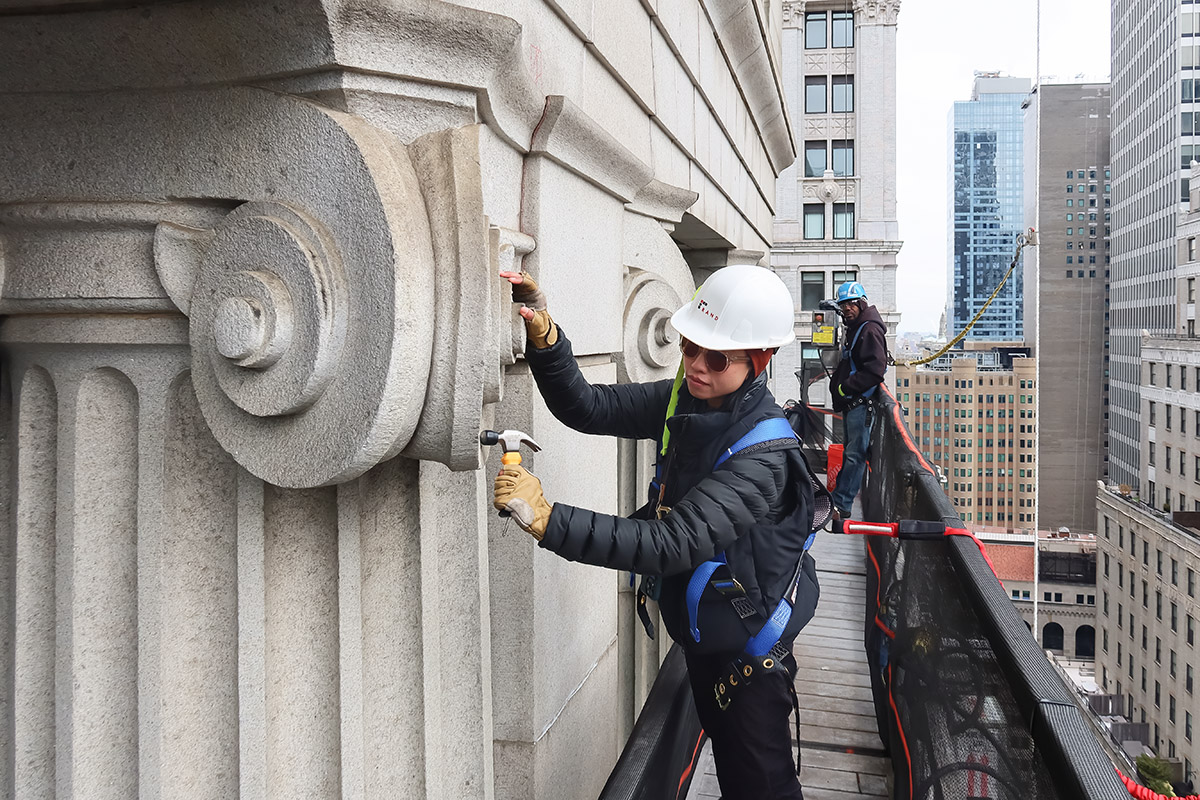
Tom Russack demonstrates stone patching to his students.

One student, for example, was accepted into the American College of Building Arts in Charleston, SC and received a scholarship for her first year of studies. Three students received a full scholarship from the World Monument Fund for a three-month training experience in Chile, where they learned adobe construction and repair while helping residents with their English language skills. Two masonry preservation graduates are working full-time at New York City masonry restoration firms, another received an apprenticeship at Evergreene Studios for interior plaster and decorative work, and several others have received internships with the Central Park Conservancy.

Masonry History Integrity, which Tom wrote with the help of a grant from the National Park Service’s National Center for Preservation Technology and Training, is being used as the official textbook for several preservation trade programs, including courses at Savannah Technical College in Georgia. It can be downloaded for free at the NCPTT website.

Rand is proud of Tom for his work developing the Youthbuild Masonry Preservation Program and teaching students the skills and attitudes necessary to become successful in the construction trades. We’re confident his comprehensive book, a true labor of love, will serve as an invaluable guide and source of inspiration for a new generation of craftsmen and women.

Restoring a Landmark on Ladies’ Mile

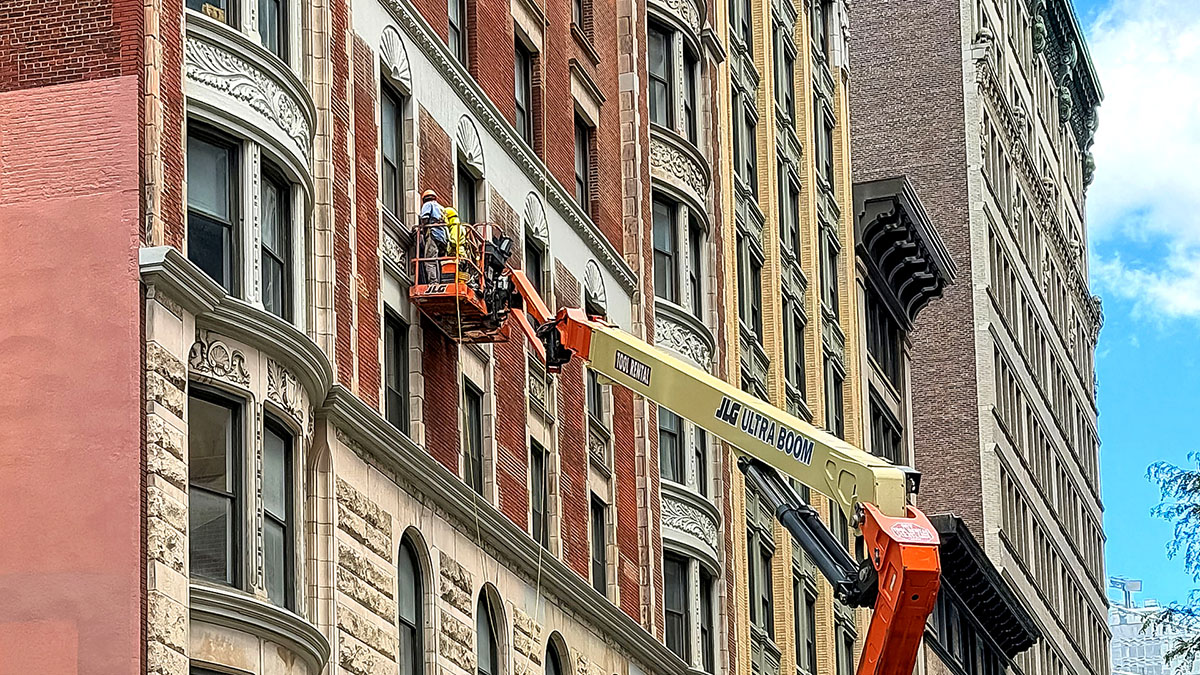
Built in 1870, the landmark building at 901 Broadway was originally home to the Lord & Taylor Dry Goods Store.

Rand was recently hired to oversee an exterior restoration and roof replacement program at 901 Broadway, which the New York Observer called “one of the most architecturally unique buildings still standing in Manhattan.”

Built in 1870, the five-story building—the first iron-framed building in New York City—has an ornate cast-iron facade, a turret, and a slate mansard roof. It was originally home to the Lord & Taylor Dry Goods store, which had moved from its downtown location at Broadway and Grand Street in 1860. In 1872 the store opened its new location at 901 Broadway, at the southwest corner of 20th Street, and soon became a tourist attraction for its elaborate steam elevator.

In 1914, Lord & Taylor moved to its current flagship store on Fifth Avenue between 38th and 39th Streets. 901 Broadway, now part of the Ladies’ Mile Historic District, was designated a New York City landmark in 1977. Last month, Brooks Brothers opened a concept store on the ground floor, a nod to its storied retail history.

The restoration project that Rand is designing and administering, scheduled to begin in the spring, will entail manufacturing and installing many decorative cast-iron elements that have been lost over the years. The mansard roof will be temporarily removed to waterproof the underlying wood deck. The existing slate shingles will then be re-installed, following the green principle of reusing materials whenever possible.

As members of the project team who will be working on the building, my Rand colleagues and I are looking forward to returning this Flatiron gem to its original glory. Even if the long-gone steam elevator is not part of the scope.

More PEs in the House

New PEs: Dave Brijlall, James Kelley

We are happy to announce that two more of our staff members are joining the ranks of Professional Engineers.

Dave Brijlall, a project engineer on Rand’s Mechanical team, and James Kelley, a senior structural design engineer on our Structural team, recently passed their Professional Engineering exams and will soon be licensed Professional Engineers in New York State.

Dave is a LEED (Leadership in Energy and Environmental Design) Accredited Professional, a Buildings Performance Institute Multifamily Building Analyst, a Certified Energy Manager, and a Level 1 Infrared Thermographer. His busy workload entails surveying, designing, and administering upgrades to HVAC, plumbing, and electrical systems. In addition, over the past year, Dave has performed a number of benchmarking surveys as well as several energy audits for buildings subject to New York City’s new Local Laws 84/09 and 87/09.

James works on a wide variety of structural design and rehabilitation projects at Rand. One of the more interesting ones is at 73 Worth Street in downtown Manhattan, where James is managing one of the largest sidewalk vault replacement programs for a residential condominium in New York City. The two-story subterranean vault, still largely supported by the original 1850s’ cast iron structural framing, is close to the A, C, and E subway lines, so the project is anything but routine. James has also been providing structural design and investigative analysis for buildings affected by the Second Avenue Subway installation, which presents its own set of challenges.

Dave's and Jim’s PE licenses bring the number of Professional Engineers on our staff to 11 (in addition to 11 Registered Architects). Congratulations, Dave and James. You’ve already made your mark on your many projects at Rand. We’re now proud to have you put your official PE stamp on them.

Giving It Our Best (Places to Work)

Crain's New York Business recently announced its top 50 Best Places to Work in New York City, and as the President of Rand, I'm happy to say we came in at number 11. We've made the list four years in a row now, so we're pretty sure it's not a fluke. Rand was also the only engineering or architectural firm named. In a city where the A/E industry plays such a major role, that's an achievement in itself.

Unlike most industry awards, which are typically chosen by a select committee of insiders or determined by the company's performance (fastest growing, highest revenues, most profitable), the Best Places to Work winners are rated by how their employees feel about working for them, based on an anonymous survey, which accounts for 75% of each company's score. An employer survey, which scores the company's policies and practices, makes up the other 25%.  

Dignity, Respect, Yoga
Crain describes the winning companies as showing a "steadfast commitment to treating employees with dignity and respect. They've also gone to tremendous lengths to imbue the workplace with warmth and a sense of fun." The fact that our employees continue to rate Rand as one of the Best Places to Work year after year gives winning a special meaning.

At Rand, we're proud of the things we offer employees to make working here more enjoyable. Extras such as on-site yoga, an in-house exercise facility, personal training, and nutritional counseling no doubt boost our ranking. But I think making the Best Places to Work list each year since its inception in 2008 points to something more than just our benefits and amenities.

Fairness Doctrine
As much as our employees say that they enjoy working at Rand, we don't pretend that everything here is Nirvana. With 65 people who have a mix of personalities, backgrounds, and styles of working, there are bound to be conflicts and differences of opinions. So the question is not whether there will be problems, but rather, how do you handle them? On that count, I believe we do extremely well.

Our employees may not agree with every decision we make, but I think most of them would say they are treated fairly and that we try to balance what's best for the individual employee with what's best for the company as a whole. I also think Rand's management has shown we don't have a hidden agenda and that we are who we say we are and do what we say we will do. As a result, our loyalty to employees has been returned to Rand—with interest.

Money Is Not the Object
Of course, compensation also plays a role in employee satisfaction. Rand maintains a salary structure that helps us attract and retain talented people while keeping us competitive in the rates we charge clients. But we've never tried to buy employees' happiness or use gigantic salaries to compensate for intolerable working conditions. If money is the main reason you get someone to work for your company, you risk their jumping ship whenever another firm dangles a little bit more in front of them. Fortunately that's not a problem at Rand.

Making the Best Places to Work list also reminds me that while I'm Rand's president, I'm also an employee. Being part of a team that relies on one another to solve problems keeps me connected to the daily challenges that each staff member faces. And belonging to a group of people who enjoy working together and take pride in what Rand does is what makes coming to the office every day worthwhile for me. Because the best places to work are the ones with the best people by your side.

Benchmarking Reports Due by December 31

Before you and your building settle in for a long winter's nap, be sure you've submitted your property's benchmarking report.

Quick refresher: Under New York City's Local Law 84/09, owners of properties larger than 50,000 square feet are required to submit their building's energy use (electricity, gas, and fuel oil or steam) every year. The utilities data from the previous year must be entered into the EPA's Portfolio Manager website.

The benchmarking law took effect this year as part of the city's Greener, Greater Buildings Plan, and the reports were originally due May 1. The city has given property owners until December 31 to submit their reports, after which they face a $500 penalty. Benchmarking reports for 2012 and subsequent years are due every May 1.

Last month the Department of Buildings sent warning letters to building owners who did not submit their benchmarking reports by August 1. If you submitted your building's benchmark report and still received this letter it may be because:

  • You submitted the report after August 1. If you received a confirmation email from the EPA, your building has complied and there is nothing further to do.
  • The borough, block, and lot (BBL) for your building was entered incorrectly or not at all. If you benchmarked before August 1, check the confirmation email to ensure the BBL is correct. If the BBL is wrong, simply enter the correct BBL and resubmit the report by December 31.

If you are not sure whether your building is 50,000 square feet or larger, check the list of buildings required to comply with Local Law 84/09. You can also visit the DOB's website for benchmarking FAQs and more information. According to the DOB, 60 to 70 percent of the buildings on the list have submitted their benchmarking report.

Benchmarking energy and water use enables owners, managers, and residents to better understand their buildings' performance and identify energy efficiency improvements that will save your building money. More than just the law, it's smart building operation.

So if your building hasn't submitted its benchmarking report, now's the time to do so. Then you can sleep in heavenly peace.

A “Real Life Architect” Goes Back to School

I recently had the pleasure of visiting a fifth-grade class at the Bloomingdale School (P.S. 145) on West 105th Street in Manhattan and talking to the students about what it's like to be a "real life architect."

The students participate in Keeping the Past for the Future, an architecture and preservation appreciation course offered at Upper West Side schools through Landmark West, a non-profit historic preservation group. Their teacher is Samantha Deutsch, who Landmark West honored this summer as an "Unsung Hero" for inspiring students (and teachers) to learn about the buildings in their neighborhood and the importance of preservation. As part of the course, Samantha leads her students on guided tours of the landmarks and historic buildings surrounding their school, using the local architecture to reinforce classroom learning.  

Before my visit, the fifth graders had observed nearby row houses and their varied ornamentation. Each student was given an outline of a row house elevation, adding details at cornice level, around the windows, and at the stoop. I brought a set of plans from one of Rand's projects at a nearby building and explained how the details for facades and roofing systems are drawn and scaled.

Next-door-renovation
Rand Architect Lynne Funk explains the details of building design to a class of budding preservationists at the Bloomingdale School (P.S. 145).

Samantha's success in engaging the kids to learn about buildings and architecture was reflected in their questions: Some of the many questions they asked were: How long does a project takes from start to finish? (From a couple of weeks to a couple of months—or sometimes even years.) Who else beside the architect works on a building? (Engineers, masons, carpenters, roofers, plumbers, electricians, et al.) What's a cornice for? (Mostly ornamental, but it also keeps water from dripping on the facade.) What should you study if you want to be an architect? (Math, design, art, writing, history.)

They were also very interested in what makes buildings stand up—and why they sometimes fall down. To explain how structural supports function, Samantha pointed to the vertical columns and horizontal beams in the classroom, and I described how concrete is reinforced with steel in buildings and how this system differs form the load-bearing walls in the row houses they drew.

I come from a family of engineers, but I loved to draw and to write, so my father steered me toward architecture. I would have loved to have been in a class like Samantha's when I was in elementary school. Based on the enthusiasm I saw in her students, I have a feeling I was looking at some future "real life architects."

Surviving the Gut Renovation Next Door

As the wife of Rand's president, I have been around building construction in New York City for more than 25 years and appreciate the energy and vitality of urban revitalization. So when our new neighbors decided to gut renovate the dilapidated brownstone next door, I was thrilled.  

Since I work at home, I volunteered to be their onsite eyes and ears while they were away during the day. I assured them I understood what was involved with a renovation project, and that they would be delighted at my level of cooperation and Zen-like spirit.

That was then. Now, four months, one call to the Buildings Department, and several red-faced tirades in my pajamas later, the eyes and ears I volunteered have taken a beating.

Next-door-renovation
Gut feeling: A major renovation next door will run you ragged if you let it.

But though my Zen-like spirit was down, it wasn't out. I've since developed a coping plan that hopefully will see me through the rest of the project. Here's my advice to those faced with a similar situation:

  • The noise and vibrations during demolition can be worse than you possibly could have imagined. Plan to be away from the house as much as possible during this phase—no earplugs can block out the sound, and your nerves will be frazzled.
  • Once the construction work begins, the noise may still get loud at times, but it is more sporadic and less psychologically discomforting than it is during demolition. Though I usually like to work in silence, I found playing music when the noise gets loud helps me focus back on my work. If music doesn't do it, a walk around the block may clear your head.
  • Although it may seem unneighborly, don't offer to help. In fact, try to keep the construction work out of your life as much as possible. If you don't, it won't take long for it to disrupt—and possibly take over—your normal routine. Be polite, but don't grant favors that intrude on your privacy or time. And put up curtains!
  • Find out at the start of the project who you should contact if there's a problem and get a hold of that person as soon as there's an issue. Keep a record of your complaints in case the condition hasn't been corrected in a reasonable amount of time.
  • Don't sweat the small stuff. If the work crew forgets to sweep up one day, let it go. Save your anger and energy for the big items—the things that are unsafe or unethical.

Remind yourself that after all the disruption is over and the project is completed, your property values will go up and you'll see a beautifully restored building next door and not an eyesore. Plus you'll have new neighbors to trade construction war stories with for years to come.

Infrared Eye for Detecting Leaks

With the recent storms and heavy rains, my Rand coworkers and I have been extra busy conducting leakage evaluations. To assist us in our investigations, we've been incorporating infrared technology.

An infrared camera has a sensor that detects temperature differences in the area being photographed and shows them as different colors. When water evaporates it cools, and the cooler areas appear as purple in the infrared images. We then visually inspect those locations to confirm that there is, in fact, water present.

The dark purple areas in this infrared photo indicate cooler spots, where water was leaking in.

Since taking a certification course in infrared building investigations a few weeks ago, I've been using the infrared camera more and more and it's been very helpful. For example, at one building where I was investigating leaks, water had damaged elevator electrical equipment, ceilings, and walls. As I would normally do, I went on the roof to look for any obvious issues that could be causing the leaks. I saw a bunch of problems: ponding (puddles), a blistering roof membrane, and missing counterflashing (a metal strip that keeps water from entering between the edge of the roofing membrane and the parapet wall).

Although the roof defects looked like they were contributing to the leaks in the elevator room (above photo), they didn't appear to be the cause of the water damage in a bathroom and bedroom several floors below. Based on the location of the damage, one possibility was that water was leaking from behind the elevator shaft. I took several infrared photos of the elevator shaft to see what might appear. Sure enough, there were streaky purple areas in the image (below), which indicated that water was running down the shaft and into the bathroom and bedroom with the affected areas.

The infrared camera detected water (purple) behind this elevator shaft, helping pinpoint the source of the leaks, confirmed through an investigative probe.

To confirm that it was a leak we were seeing in the infrared photo, and to figure out where it might be coming from, I asked the contractor to conduct an investigative probe into the bathroom wall on the 14th floor. When we opened up the wall we saw a crack in the hub on a plumbing riser, which was overflowing with water. The water was then traveling down from floor to floor through the riser penetrations, ending up at the 11th floor bathroom ceiling, where the damage was evident.

Thanks to the infrared images, we were able to pinpoint the source of the leak more quickly than if I conducted just a visual survey. Plus, we needed to conduct only one investigative probe instead of several, so we saved our client both time and money.

The infrared technology is not a miracle tool, of course. You still have to perform a visual examination to confirm that the purple spots are water related and possibly use a moisture meter and conduct investigative probes when necessary. Some spots that appear as purple in the infrared photos may not be water—they could be cooler areas caused by drafts or missing insulation, for example. But even in those cases, the infrared camera helps point out heat and energy losses that should be looked at.

The infrared camera that Rand uses (FLIR ThermaCAM T300) is not cheap—it cost $8,300 (which, adding in the cost of the training, led Rand's president to joke about the leaks in Rand's expenses). But given the number of leakage investigations that Rand does and the advantage we think the camera provides, we see it as a worthwhile investment that will pay off for us and for our clients. I'm now taking my Level II thermography training and looking forward to learning advanced diagnostic techniques, which I will write about in a future post.

If your building has had a leak investigation using an infrared camera, I'd be interested in hearing how it went, so please leave a comment below. I'm also happy to answer any questions you have on the technology, so feel free to contact me at i...@randpc.com.