
Energy Audit Fact Sheet
Why an Energy Audit?
An energy audit provides property owners with an analysis of how efficiently their buildings’ systems are performing and identifies ways to reduce overall energy consumption. The audit serves as a blueprint for developing an Energy Action Plan, which includes a list of low-cost energy-saving measures and potential capital improvements that can reduce the building’s operating costs when implemented.
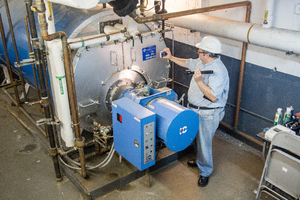
During an energy audit, the engineer surveys the building’s major systems and components, such as the boiler and burner, to evaluate their performance.
Energy Audit Standards
RAND’s energy audits are conducted in accordance with BPI (Building Performance Institute) and ASHRAE (American Society of Heating, Refrigerating, and Air-Conditioning Engineers) standards. ASHRAE audits comply with New York City Local Law 87 and Local Law 97, designed to improve the energy efficiency of existing buildings.
Energy Audit Items
An energy audit consists of the following three items:
1. Review of Utilities Usage:
RAND reviews the building’s energy bills to analyze natural gas, fuel oil, and electricity use over a continuous 12-month period within the last two years. The review looks at patterns of energy use, including peaks, valleys, trends, and any unusual signs that could indicate operational or usage abnormalities.
The information is compiled to determine the building’s Energy Utilization Index (EUI), which is compared to the EUIs of similar buildings. If the building’s systems are performing very efficiently, then an energy audit may not be necessary. If the EUI indicates that the building can improve its energy savings, then the audit would proceed with a survey of the building’s systems.
2. Systems Survey:
A RAND team of BPI Certified Professionals surveys the building’s major systems and conditions, including:
- Building Envelope (Walls, Windows, and Doors)
- Roofing System and Roof-level Components
- Heating, Ventilation, and Air Conditioning
- Electrical and Lighting
- Elevator
- Motors and Pumps
3. Energy Analysis Report:
Based on our survey and utilities analysis, RAND will prepare a written report that details our findings and provides a recommended scope of work for improving energy efficiency and management with estimates of potential costs and savings. After issuing the report, RAND meets with the building’s owner to discuss it in detail, answer questions, and help develop a cost-effective Energy Action Plan.
Three Energy Audit Levels
Level 1:
In a Level 1 energy audit, RAND’s survey team walks through the building recording observable sources of energy loss or deficiencies that can be corrected with low- or no-cost repairs and installations, such as replacing incandescent bulbs with compact fluorescent lighting, lowering the boiler cycle time, installing insulation around a drafty window, lowering domestic hot water temperature, insulating ductwork and piping, etc.
Level 2:
An audit identifies
ways to reduce
energy consumption.
A Level 2 energy audit entails a more detailed building survey and includes computer-generated energy modeling used to develop an Energy Action Plan. Some of the systems and components analyzed in a Level 2 audit are boilers, chillers, piping, pumps, ventilation controls, steam traps, and insulation.
The Energy Action Plan in a Level 2 audit outlines low- and no-cost measures that improve energy efficiency. The plan also recommends adjustments and basic capital improvements that can be made to major building systems, such as HVAC, electrical, and plumbing, to optimize their operational performance.
Level 3:
A Level 3 energy audit expands on the review and analysis of the building systems and components performed in Level 1 and 2. In addition to listing low- and no-cost measures and minor adjustments to improve operating efficiency, the Energy Action Plan in a Level 3 audit includes detailed recommendations for major capital improvements, such as a heating plant upgrade, roof replacement, re-piping program, etc., that would provide the greatest measures of energy savings.
New York City’s Energy Audit Requirement
In December 2009, the New York City Council passed the Greener Greater Buildings Plan, designed to improve the energy efficiency of existing buildings. Among the items in the legislation, known as Local Law 87/09, owners of buildings 50,000 square feet or larger are required to have an energy audit conducted every 10 years and identify and correct any deficiencies through repairs, adjustments, cleanings, and operational practices. An energy efficiency report, documenting the building’s energy usage and operations, must then be filed with the city.
The due dates for the energy efficiency reports are based on the last digit of the building’s block number. Buildings with block numbers ending in 4 will file by December 31, 2024; buildings with block numbers ending in 5 will file by December 31, 2025, and so on. The audit can be conducted up to four years before the EER is due, so owners and managers can start the process early to give themselves enough time to perform the necessary retro-commissioning measures to comply by the filing deadline.
In 2019, the New York City Council passed a series of laws, together known as the Climate Mobilization Act (CMA), an effort to mitigate the risks and effects of climate change. Local Law 97/19, the centerpiece of the legislative package, directly aims to achieve citywide greenhouse gas emissions reductions, by setting strict emissions caps on large residential and commercial buildings 25,000 square feet or larger. Two initial compliance periods from 2024 – 2029 and 2030 – 2034 are detailed in the law, with future compliance requirements through 2050 to be determined by the City. The caps become significantly more stringent with each succeeding compliance period.
The very first compliance report is due by May 1, 2025, with filings due by May 1 of every year thereafter. Building owners should work with a registered design professional as soon as possible to start developing short- and long-term energy and carbon reduction strategies to prepare for compliance and avoid steep penalties.
Together, these laws aim to combat climate change by reducing greenhouse gas emissions and improving energy efficiency in buildings The Local Law 87/09 energy audit is an important tool to help provide a roadmap to achieve the emissions target set in Local Law 97/19 by identifying cost-effective energy saving measures for buildings.
Choosing The Level Audit That Is Right For Your Building
The type of energy audit best suited for your building depends largely on the size, age, and condition of the property. For smaller buildings (typically less than 10 units) with basic mechanical systems, a Level 1 audit is likely sufficient, while larger buildings with more extensive systems probably require a Level 3 audit. Older buildings with aging heating, electrical, and plumbing systems, as well as buildings that have not been well maintained, would also be better served with a Level 2 or 3 audit, whereas a more recently built building fitted with energy-efficient components may need only a Level 1.
New York City’s Local Law 87/09 requires buildings larger than 50,000 square feet to have a Level 2 energy audit conducted every 10 years.
As part of our initial evaluation of a property, RAND will provide owners with a proposal recommending which energy audit level is best suited for their property and outlining the scope of work and cost involved for each level.