
NYC Sidewalk Sheds: Requirements, Maintenance, and Removal
By Stephen Varone, AIA and Peter Varsalona, PE
In New York City, sidewalk sheds protect pedestrians from falling debris during facade repairs and when unsafe exterior building conditions are present. But when construction is delayed, a shed can become a source of frustration for building owners, residents, and neighboring businesses. Whether a sidewalk shed can be removed depends on the building’s condition and NYC Department of Buildings (DOB) requirements.
A reader raised this very issue in RAND’s Ask the Engineer column:
Last spring, our 12-story co-op in the Bronx began a major exterior repair job. After a few weeks of construction, the project was put on hold because of problems with the contractor, whom we subsequently fired. The board is planning to put the project out to bid again, and it looks like the work won’t resume until the spring. In the meantime, the sidewalk bridge installed in the front of the building is still up, and the owner of the dry cleaner next door has complained to our board that it blocks the sign to his store.
In addition, the residents on the second floor of our building are grumbling that the bridge blocks out natural light into their apartments and that the debris and razor wire on the bridge are ugly. Plus, most of the lights under the bridge are broken, making it dark at night. Must we keep the bridge up throughout the winter even though there’s no repair work going on, or can we have it taken down and then put back once the project starts up again in a few months? There are no signs on the shed, so we’re not sure whom to contact.
Your board’s concerns are understandable. Sidewalk sheds can obstruct storefronts, reduce natural light, and inconvenience residents and pedestrians, particularly when construction is delayed. But because their primary purpose is public safety, removing a sidewalk shed isn’t simply a matter of whether repair work is actively taking place.
When a Shed Is Required
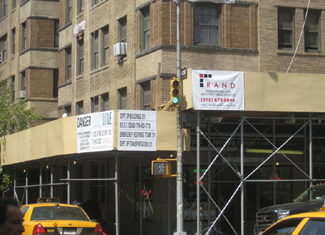
While it is understandable that the owner of the dry cleaner next door does not like the sidewalk shed blocking his store sign, the New York City Building Code requires sidewalk sheds to protect pedestrians during certain exterior construction and repair activities. Depending on the height and location of the work, a shed may need to extend beyond the area being repaired, including onto the sidewalk in front of neighboring properties. For exposed work more than 100 feet above ground, the required extension is generally 20 feet beyond the protected area on each side, subject to applicable code exceptions and site conditions.
The DOB also says that the sidewalk shed must not “unreasonably obstruct, either visually or physically, entrances, egress, driveways, and show windows of adjacent properties.” Store signs are another matter, however, and sometimes the shed installation cannot avoid blocking them. In such cases, a temporary store sign is usually installed on the shed, which your co-op should do as a courtesy for the dry cleaner.
A sidewalk shed should not be used to store tools or dump debris.
As for the second floor residents in your building, they unfortunately will have to bear the inconvenience of the shed blocking out natural light into their apartments. However, razor or barbed wire installed on a sidewalk shed is prohibited and should be removed. The sidewalk shed also should not be used as a storage area for tools or materials or a dumping ground for litter or other debris. In addition, the broken lights under the shed are a safety hazard and must be immediately fixed.
The DOB requires identifying information to be displayed on sidewalk sheds, including applicable permit information and contact details for the permit holder. If the required signage is missing, building management should verify the shed’s permit status through DOB records and contact the permit holder to address any outstanding issues. Unsafe conditions, such as broken lighting or improperly maintained shed components, can also be reported through 311.
Shed Removal
If your building has Unsafe conditions under New York City’s Facade Inspection Safety Program (FISP), formerly Local Law 11, such as loose masonry or deteriorated facade components that pose a hazard to pedestrians, the sidewalk shed or other required protective measures must remain in place until the conditions have been addressed and the appropriate approvals obtained. The same applies when previously identified repair conditions have deteriorated or resulted in an Unsafe classification.
If a facade has unsafe conditions, the shed must stay in place even if the project is on hold.
If the building’s exterior conditions no longer require sidewalk protection, removal may be possible even if the overall repair project has not been completed. The building’s engineer or architect should evaluate the conditions and determine whether the shed is still necessary. A request for full or partial sidewalk shed removal must be submitted through DOB NOW: Build, followed by a DOB inspection and approval before removal.
There is also a financial consideration. Removing a sidewalk shed during a construction delay, only to reinstall it a few months later, may cost considerably more than maintaining it in place. Installation, dismantling, and rental costs vary depending on the size and configuration of the shed, site conditions, and the anticipated duration of the work. Before deciding, the board should compare the cost of keeping the shed with the cost of removal and reinstallation, while accounting for the building’s safety obligations.
Permit Renewals
Under current NYC Department of Buildings requirements, sidewalk shed permits generally must be renewed every 90 days. The permits are not automatically renewed, and the permit holder must submit the required renewal information and fees through DOB NOW.
For sidewalk sheds associated with facade repairs, permit renewals generally require a report prepared by a registered design professional documenting the building conditions, work completed since the previous renewal, work currently underway, and estimated time needed to complete the repairs. Certain exemptions apply, including sheds associated with one- or two-family homes and permitted new building, enlargement, or demolition work.
Building owners must also keep sidewalk sheds properly maintained throughout their use, regardless of whether construction is actively underway. Lighting, signage, structural components, and other safety features must remain in acceptable condition. Where no work is taking place, the building owner is responsible for the shed’s maintenance and use.
New York City has also increased oversight of sidewalk sheds that remain in place for extended periods. Under Local Laws 48 and 51 of 2025, qualifying building owners may face penalties when required repair work is not progressing or when applicable facade repair milestones are missed. These penalties depend on the circumstances and applicable requirements; a shed remaining in place for a certain number of years does not automatically trigger a penalty.
Moving Forward with Facade Repairs
Winter shutdowns and unexpected project delays are not unusual in exterior repair programs. But leaving a sidewalk shed in place indefinitely is not a substitute for addressing the underlying building conditions. Aside from the inconvenience to residents, neighboring businesses, and pedestrians, prolonged delays may expose building owners to additional DOB scrutiny and penalties.
It’s also important to remember that while sidewalk sheds are designed to provide protection, they cannot eliminate every hazard. Falling tools, bricks, masonry, and other debris can bounce off the shed or miss it altogether. Your board’s priority should be to engage a qualified contractor, resume the necessary repairs, and have the shed removed as soon as conditions permit.
In the meantime, repairing the broken lights, removing the razor wire and debris, addressing the dry cleaner’s signage concerns, and confirming that the shed is properly permitted and maintained will go a long way toward addressing the immediate concerns of residents and neighbors.
Stephen A. Varone, AIA, is President, and Peter E. Varsalona, PE, RA, CEM, CBCP, is Principal of RAND Engineering & Architecture, DPC. This article was adapted from their Ask the Engineer column, originally published in the February 2012 issue of Habitat Magazine.