
NYC Parking Garage Inspection Requirements: PIPS and Local Law 126
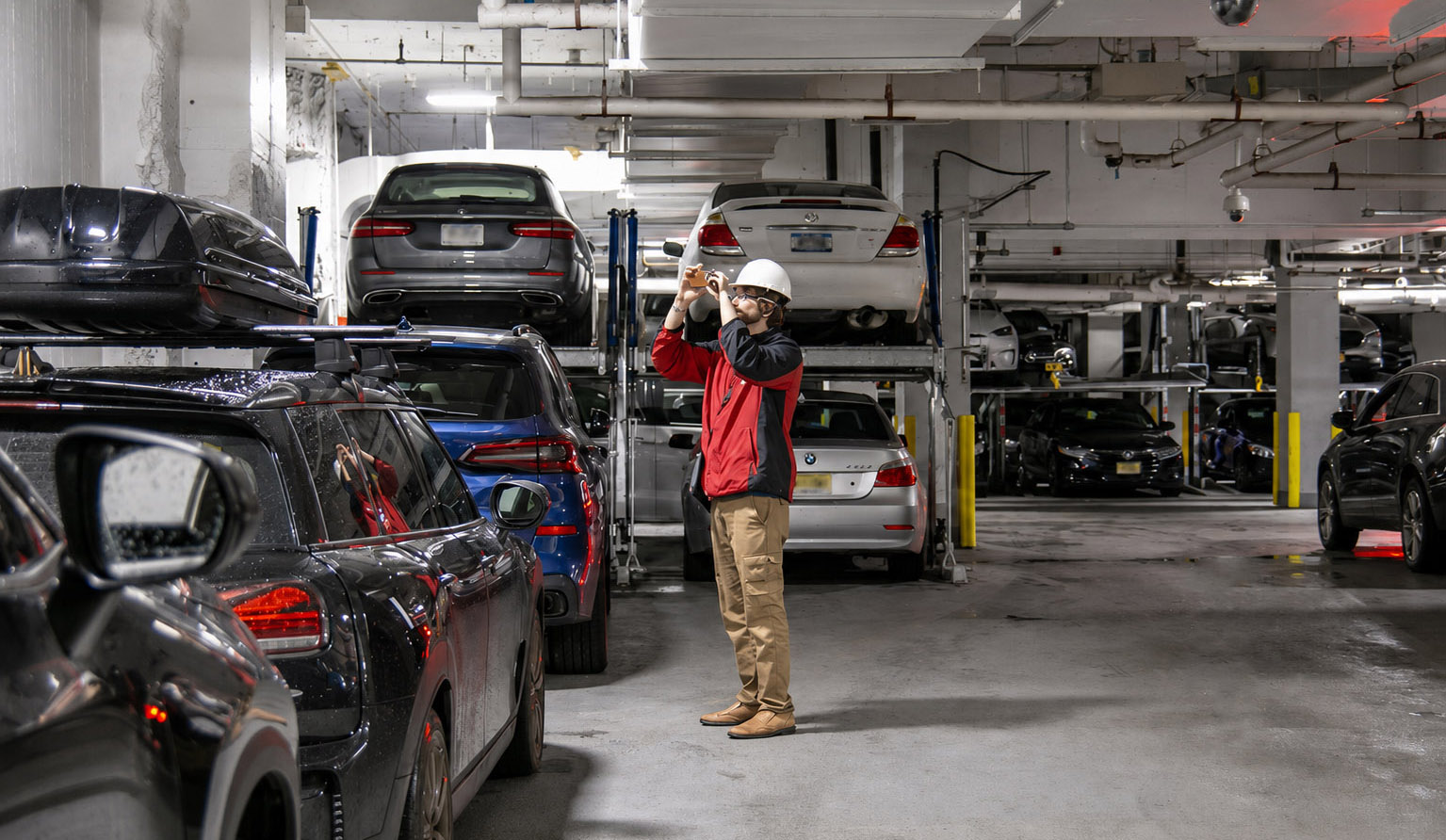
New York City parking structures are required to undergo regular inspections by a qualified engineer in compliance with Local Law 126 of 2021.
New York City’s Local Law 126 established the Periodic Inspection of Parking Structures (PIPS) program for parking garages and other covered parking structures. Parking structures face continual exposure to vehicle traffic, moisture, deicing salts, temperature changes, and other conditions that can accelerate deterioration, particularly when maintenance is deferred. If left unaddressed, corrosion and deterioration of concrete and steel can lead to unsafe structural conditions.
For owners and managers, PIPS compliance can extend beyond the initial inspection and filing to repairs, engineering monitoring, follow-up assessments, and annual observations. Understanding which structures are subject to PIPS, how condition assessments and DOB filings work, and what is required before and after a report is submitted can help owners meet their responsibilities and plan for necessary repairs.
What is Local Law 126 and the Periodic Inspection of Parking Structures (PIPS) program?
In response to the 2015 collapse of a two-level parking structure near Binghamton, New York, the state implemented a mandate for periodic assessments of parking garages. Previously, New York City was exempt from these state regulations.
Effective January 1, 2022, Local Law 126 of 2021 introduced Article 323 to Title 28 of the Administrative Code, requiring NYC parking structures to undergo periodic condition assessments. As amended by Local Law 71 of 2024, parking structures must have an initial condition assessment by January 1, 2028, and, after January 1, 2028, must undergo condition assessments at least once every four years. The Department of Buildings (DOB) refers to these regulations as the Periodic Inspection of Parking Structures (PIPS) program.
Under the law, parking structure owners must engage a New York State licensed professional engineer designated as a Qualified Parking Structure Inspector (QPSI) to assess the building’s structure and appurtenances. The condition assessment must be performed by or under the direct supervision of the QPSI. The QPSI must have relevant parking structure experience and complete the formal certification process required by the New York City Department of Buildings (DOB).
The QPSI is responsible for designing the condition assessment program, supervising the inspection process, performing the required final inspection, determining the filing classification, and filing the condition assessment report with DOB. The report classifies the parking structure as Safe, Safe with Repairs and/or Engineering Monitoring (SREM), or Unsafe. This inspection process is similar to the city’s Facade Inspection Safety Program (FISP) for periodic facade inspections.
What does the inspection entail?
As part of the inspection process, also known as a condition assessment, the following must be reviewed if available: structural design or repair drawings, violations, and FISP reports where applicable. Starting with the second cycle, the most recent compliance report, any available previous reports, and all annual observation checklists for the prior cycle must also be reviewed.
The QPSI must then design a condition assessment program based on the type of construction of the parking structure, age of the material components, environmental conditions, and the presence of specific details and appurtenances. Consideration must also be given to the structure’s history of maintenance and repairs.
The inspection is conducted through a combination of visual and hands-on evaluation, as follows:
Visual Inspection
The visual inspection is conducted using high-powered binoculars (where necessary) and high-resolution cameras.
Physical Examination
Physical examination must be conducted on a minimum of 10% of each type of structural element (e.g. beams, columns, slabs) within the parking structure, with a focus on any areas with observed deterioration. The physical examination will include, but not limited to, sounding, load tests, optical surveys, non-invasive scanning, and cores where applicable.
Note: The facade of the structure can be excluded from the scope of the inspection if the building is already subject to FISP requirements, or the parking structure takes up less than 50% of the total building square footage.
What are the report requirements?
The condition assessment report must include documentation of existing conditions, description of the structure’s load-resisting systems, maintenance and repair history since the previous inspection cycle, itemized recommendations with a specific timetable for each repair item, photographs of representative conditions, and a site plan indicating required work locations.
The QPSI must also develop a unique annual observation checklist during each condition assessment, containing baseline items that must be inspected annually or at more frequent intervals.
What is the annual observation checklist and annual observation requirement?
During each PIPS condition assessment, the QPSI develops a unique annual observation checklist for the parking structure.
After the current cycle’s PIPS compliance report has been accepted by DOB, the owner is responsible for having an annual observation performed each year based on the checklist included in the most recent accepted report. The annual observation must be performed by or under the direct supervision of a QPSI.
Any Unsafe conditions observed during the annual observation must be reported to DOB. Completed annual observation checklists must be kept at the parking structure and made available to DOB and the QPSI upon request. They are not submitted to DOB each year.
What are the filing classifications?
Safe: Parking structures filed as Safe require no further action.
Unsafe: Conditions that are hazardous to persons or property and require repair within 90 days from the submission of the compliance report.
Safe with Repairs and/or Engineering Monitoring (SREM): Conditions that are Safe at the time of inspection but require repair and/or engineering monitoring to prevent deterioration into Unsafe conditions will be filed as SREM. For each SREM condition, the QPSI must recommend repairs, monitoring as applicable, and a specific repair time frame.
What happens if an Unsafe condition is found?
If an Unsafe condition is discovered, the DOB must be notified immediately, and appropriate protective measures recommended by the QPSI must be taken.
Once a building has filed an Unsafe Report, owners must either complete required repairs to correct any Unsafe condition within 90 days, or where 90 days is not a sufficient amount of time to complete the work, submit an extension request to the DOB.
The DOB typically grants a 90-day extension, as long as adequate safety measures are in place and the QPSI has recommended a repair timetable. Additional extensions can then be requested and granted every 90 days as needed, until the work is completed. As long as extensions are approved and maintained during the repair program, DOB will not assess fines for failure to correct Unsafe conditions.
The owner is responsible for making repairs to correct Unsafe conditions within the required timeframe. Within two weeks after Unsafe conditions have been corrected, the QPSI must inspect the parking structure and file an Amended Report to upgrade the building status to SREM or Safe. If the report is rejected by the DOB, a revised report must be filed within 45 days of the date of the rejection. Protective measures must remain in place until an Amended Report is accepted.
When must SREM conditions be repaired by?
Owners must correct SREM conditions within the specific repair time frame recommended by the QPSI and prevent those conditions from deteriorating into Unsafe conditions. A follow-up assessment is required no more than two years from the date of the initial assessment, after which an amended report must be submitted to DOB. The QPSI must file the report within 60 days of the final inspection date.
It is important to note that outstanding SREM conditions cannot be carried over from one inspection cycle to the next. Any condition reported as SREM that is not corrected by the next cycle inspection must be reported as Unsafe.
When are the inspection and report deadlines?
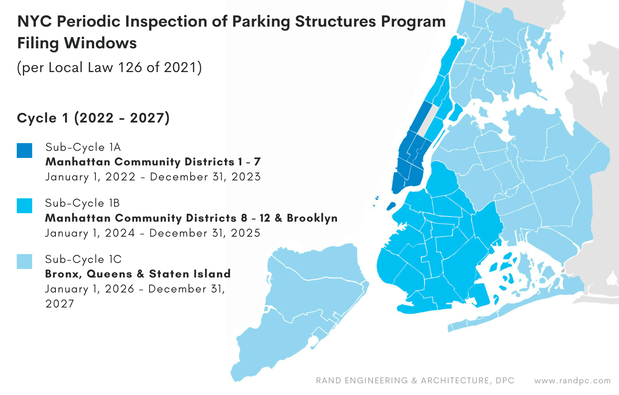
Parking structure inspection and report filing deadlines are divided into cycles and sub-cycles based on borough and Community District. Cycle 1 is divided into three two-year filing windows in which condition assessment reports must be filed. The filing windows for Cycle 1, which began on January 1, 2022, are as follows:
- A: Manhattan Community Districts 1, 2, 3, 4, 5, 6, and 7 (59th Street and below, and Upper West Side to 110th Street). Reports must be filed between January 1, 2022 and December 31, 2023.
- B: Manhattan Community Districts 8, 9, 10, 11, and 12 (Upper East Side above 59th Street, and all of Upper Manhattan above 110th Street); and all Brooklyn Community Districts. Reports must be filed between January 1, 2024 and December 31, 2025.
- C: All Bronx, Queens, and Staten Island Community Districts. Reports must be filed between January 1, 2026 and December 31, 2027.
Beginning January 1, 2028, parking structure condition assessments will be required at least once every four years. Parking structures classified as Safe with Repairs and/or Engineering Monitoring (SREM) must be subsequently assessed no more than two years from the date of the initial assessment, with an amended report filed with the DOB.
Initial Observation Report Requirement
The DOB required certain Sub-cycle 1B and 1C parking structures to complete and file a one-time Initial Observation Report by August 1, 2024. The observation had to be performed by or under the direct supervision of a QPSI.
This requirement applied to parking structures in Manhattan Community Districts 8 through 12, Brooklyn, Queens, Staten Island, and the Bronx that are subject to PIPS and required to file full condition assessment reports by December 31, 2025 or December 31, 2027.
The Initial Observation Report is separate from the full PIPS condition assessment report. Owners that missed the Initial Observation Report deadline may already have a violation or penalty to address.
For owners of parking structures in upper Manhattan, Brooklyn, Queens, the Bronx, and Staten Island who have not yet completed the required Initial Observation Report, schedule an inspection with a QPSI as soon as possible. Read our Initial Observation Inspection FAQ for more information.
When must new buildings file?
Initial compliance reports for newly constructed buildings governed by Parking Structure Inspection reporting requirements must be filed based on the date the initial Temporary Certificate of Occupancy (TCO), Interim Certificate of Occupancy (ICO), or Certificate of Occupancy (CO) was issued and the property’s applicable sub-cycle filing window.
If the six-year anniversary of the initial TCO, ICO, or CO falls within the property’s applicable sub-cycle filing window, the initial report must be filed by that filing deadline.
If the six-year anniversary falls outside the property’s applicable sub-cycle filing window, the initial report must be filed within the applicable filing window for the next inspection cycle.
Because filing timing for newly constructed parking structures depends on the certificate date, sub-cycle, and DOB requirements in effect at the time, owners should confirm their deadline with DOB or a QPSI before relying on a projected future cycle date.
What kinds of parking structures must be inspected in New York City?
Parking structures that meet inspection requirements include:
- Buildings, or portions of a building, used for parking or storing motor vehicles, including space inside or underneath buildings
- Open parking garages and enclosed parking garages as defined in the NYC Building Code
What types of parking structures are exempt from New York City inspection requirements?
Exempt from compliance are:
- Autobody and automotive repair shops, automotive showrooms, and automotive service stations
- Loading docks
- Garages with occupancy of fewer than three cars
- Unenclosed, unattached outdoor parking lots
- Private garages serving one- and two-family homes
What’s the difference between a Subsequent Report and an Amended Report?
A Subsequent Report changes the status of a previously filed Safe or SREM Report within a six-year report filing cycle, reflecting changed conditions or the recommended time frame for repairs of SREM or Unsafe conditions. An Amended Report changes the status of a previously filed Unsafe Report to SREM or Safe after Unsafe conditions reported in the initial report have been repaired.
What is an appurtenance?
In addition to the main structural components of a parking facility, appurtenances must also be examined by the QPSI. Appurtenances are supplementary elements that enhance and support the primary functions of a parking structure, encompassing a range of architectural, structural, and operational features.
These include, but are not limited to, rolldown gates, attendant booths, lighting fixtures, gates, staircases, fire protection, column protection, signs, parapets, railings, guard rails, enclosures, antennae, bollards, vehicle barriers, vehicle impact protection, electric vehicle charging stations, and any other equipment attached to the parking structure.
Not considered appurtenances: mechanical devices for vehicles moving from and to street levels or within the structure such as parking machines, lifts, mechanical stackers, automated parking systems, and elevators in which public occupancy is prohibited.
What are the filing fees?
The DOB currently lists the following filing fees for parking structure compliance reports:
Initial filing: $485
Subsequent filing: $485
Amended Filing: $940
Extension of time to complete repairs: $95
The DOB also lists additional fees for waiver requests, inspections made necessary by failure to file, parking structure verification requests, and partial protection removal requests. Owners should confirm current DOB fees at the time of filing, as fees may change.
What are the civil penalties for non-compliance?
The DOB lists the following core civil penalties for parking structure reports:
Late Filing: $1,000/month.
Failure to File: $5,000/year.
Failure to Correct Unsafe Conditions: $1,000 per month
Failure to Correct SREM Conditions: $2,000 one-time penalty
Civil penalties for late filing and failure to file apply after the filing period ends. Unsafe conditions must be corrected within 90 days of filing a report with an Unsafe status, or repair extension requests must be filed. An amended report must then be filed within two weeks after repairs are completed.
Additional DOB/OATH violations may apply in certain situations, including failure to conduct required annual observations, failure to notify DOB of conditions that may be hazardous to the public, failure to take required public safety measures, failure to file required amended reports, false statements, unsafe general building maintenance, or related exterior wall violations. Some of these violations can carry higher penalties.
Owners should confirm property-specific violations and penalties before assuming which penalties apply.
Can you challenge a penalty?
Owners may challenge a penalty by providing proof of compliance. Proof must include, although is not limited to, a copy of an acceptable initial compliance report, a copy of the acceptable amended report, copies of approved extension of time requests while work was/is in progress or written proof from a QPSI that the unsafe conditions observed at the parking structure were corrected and the violation was dismissed.
Challenges must be made in writing within 30 days from the date of the violation and sent to the office/unit of the DOB that issued it.
Is New York City subject to the New York State Parking Garage Rule?
Since 2019, New York State has required that owners of parking garages obtain an operating permit and conduct periodic inspections at least every three years. Each city, town, village, county, or governmental unit/agency, also known as the “authority having jurisdiction,” is responsible for administering and enforcing the rule. However, New York City maintains its own building code requirements, so buildings within the city boundaries are not subject to the state’s deadline.
An Ounce of Prevention
Regular maintenance is essential for the safe and efficient operation of any building, including parking structures. This involves conducting regular inspections, implementing preventative measures, and promptly addressing any issues to prevent them from becoming larger problems. Following these best practices can help to enhance the safety and longevity of parking structures.
To learn more about these maintenance guidelines, please refer to our article on Maintenance Best Practices for Parking Structures.
The harsh winter conditions in New York City can be particularly challenging for parking structures, as they can cause rapid deterioration of concrete and steel. As a result, owners must be diligent about maintaining their structures to prevent any potential issues caused by these conditions.
The Periodic Inspection of Parking Structures program/Local Law 126 of 2021 plays a critical role in maintaining the safety of New York City’s parking structures. Although complying with strict inspection and maintenance protocols might seem onerous, these measures ultimately help prevent more costly future repairs, safeguard personal property, and minimize the risk of catastrophic failures that could endanger lives.
Contact RAND
Our parking structure-related structural engineering services include:
- NYC Periodic Inspection of Parking Structures (PIPS)/Local Law 126/21 inspections conducted by experienced QPSIs
- Compliance assistance for parking garage inspection and reporting requirements
- Comprehensive parking garage inspections to identify structural issues
- Initial Observation Reports
- Condition assessment reports
- Repair design and repair-phase support
- Structural assessments and maintenance recommendations
- Emergency inspections for structural failures or urgent situations
- Damage assessment and repair services following emergencies or natural disasters
For more information on New York City’s Periodic Inspection of Parking Structures (Local Law 126) program, or to schedule an inspection with a RAND QPSI, contact RAND at 212-675-8844 or info@randpc.com.