
Local Law 152 of 2016: Periodic Inspection of Gas Piping
A gas explosion due to two improperly welded Consolidated Edison gas pipes leveled two buildings in East Harlem in 2014, killing eight people, injuring at least 70 others, and displaced over 100 families. A year later, an illegal tap into a gas main in the East Village led to a gas explosion which killed two people, injured nineteen, and destroyed three buildings located in the East Village/Lower East Side Historic District. In the wake of these catastrophic gas explosions, New York City enacted a series of gas safety laws in 2016, including Local Law 152 of 2016, which requires the periodic inspection and testing of gas piping systems.
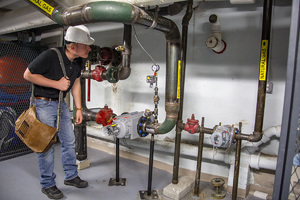
What does the Local Law 152 inspection and certification process entail?
As of January 1, 2020, gas piping systems in most buildings must be inspected by a Licensed Master Plumber (LMP), or a qualified individual working under the As of January 1, 2020, gas piping systems in most buildings must be inspected by a Licensed Master Plumber (LMP), or a qualified individual working under the supervision of a LMP, at least once every four years.
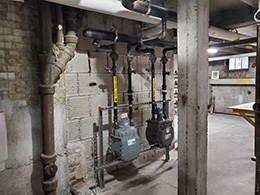
LMPs will be inspecting all exposed gas lines at the point where gas piping enters into a building, including building services meters, up to individual tenant spaces, for evidence of:
- Excess atmospheric corrosion or piping deterioration that has led to an unsafe conditions
- Gas leaks
- Illegal connections (such as theft, diversion of service, cross connections or connections made with substandard parts or materials)
- Non-code compliant installations
In addition, public spaces, hallways, corridors, and mechanical and boiler rooms that contain gas piping or gas utilization equipment must be tested with a portable combustible gas detector to determine if there is any gas leak.
Inspection report
Within 30 days of the inspection, the LMP must provide a Gas Piping System Periodic Inspection Report (GPS1) to the owner of the building noting all conditions observed and identifying corrections, if any, that need to be made.
Inspection certificate
Within 60 days of the inspection, the building owner must submit a Gas Piping System Periodic Inspection Certification (GPS2) signed by the LMP to the New York City Department of Buildings (DOB) through the online portal at http://www.nyc.gov/DOBgaspipecert. Failure to file within 60 days will require a new inspection.
If any conditions requiring correction were found and indicated by the LMP on the certification, the building owner has 120 days from the initial inspection to make the necessary corrections and submit a new certification to the DOB signed by the LMP. If needed, an additional 60 days may be requested to perform the corrections if indicated by the LMP. It should be noted that any corrections made must comply with the New York City Construction Codes, including the procurement of any required work permits.
All reports and certifications must be kept on file for 10 years after the inspection date, and be made available to the DOB upon request.
What type of buildings does the law affect?
All buildings with gas piping systems must comply except for those in occupancy group R-3. Buildings classified as group R-3 includes buildings or portions of buildings that have no more than two dwelling units, such as single and two-family homes, and group homes such as convents and monasteries with fewer than 20 occupants. To identify a building’s classification, the occupancy group can be found on the building’s Certificate of Occupancy.
When are the inspections due?
Inspection and certification filing windows are organized by community district and are one year long, with the first ever cycle having begun on January 1, 2020. To identify your community district, search by address at communityprofiles.planning.nyc.gov. After the initial cycle, inspections must be performed and submitted every four years. The second cycle of inspection windows for the four groups of community districts are as follows:
| Date Range for Inspection | Buildings in Community Districts |
| January 1, 2024 – December 31, 2024* | 1, 3, and 10 in all boroughs |
| January 1, 2025 – December 31, 2025* | 2, 5, 7, 13, and 18 in all boroughs |
| January 1, 2026 – December 31, 2026* | 4, 6, 8, 9, and 16 in all boroughs |
| January 1, 2027 – December 31, 2027* | 11, 12, 14, 15, and 17 in all boroughs |
* and no later than December 31 within every fourth calendar year thereafter
Inspection certifications may be submitted early, but the inspection cannot be conducted more than 60 days before the official due date. For example, a building located in Community District 11 may not have their Local Law 152 inspection conducted before November 2, 2022 for the first cycle of inspections.
When are the inspections due for new buildings?
New buildings must be inspected for the first time in the tenth year after a temporary or final certificate of occupancy or letter of completion is issued. Subsequent inspections must follow the above schedule by community district.
What is the penalty for non-compliance?
Failure to file the Gas Piping System Periodic Inspection Certification by the corresponding deadlines is regarded as a major violation (Class 2) and may result in court hearings and a civil penalty of $10,000.
Building owners may challenge a civil penalty by submitting, in writing, satisfactory proof of a timely and acceptable filing to the DOB within 30 days from the date of the violation.
What about buildings without gas piping systems?
Owners of buildings without gas piping systems must also submit a Gas Piping System Periodic Inspection Certification (GPS2) signed by a registered design professional stating that the building does not contain gas piping. This must also be done every four years within the inspection window of the community district the building is located in.
What if a unsafe or hazardous condition is found?
If any unsafe or hazardous condition(s) are observed, the LMP must immediately call 911, notify the building owner, the utility company providing gas service to the building, and the DOB. The building owner is responsible for notices to all the residents, and must take immediate action to correct the condition(s) in compliance with the NYC Construction Codes.
What are other gas safety laws?
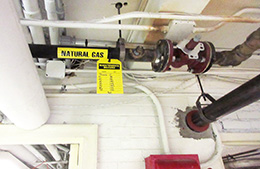
To prevent conditions that might lead to gas explosions, New York City has enacted a series of gas safety laws. The most important to know for your building’s safety include:
Local Law 150 of 2016: All “gas work” other than that performed, serviced, and maintained by utility companies must be performed by a Licensed Master Plumber (LMP) with gas work qualification. Effective January 1, 2020.
Local Law 151 of 2016: The final inspection of gas piping systems must be performed by the DOB in the presence of the permit holder, the registered design professional of record, or the superintendent of construction. Any defects noted must be corrected. Self-certifications are no longer allowed for any “gas work” throughout New York City. Effective January 1, 2018.
Local Law 153 of 2016: Owners must notify their residents of the correct procedures to follow if they suspect that there is a gas leak. Effective April 2017.
Local Law 154 of 2016: Gas utility companies must notify the DOB within 24 hours if gas is shut off and/or not restored after inspection because of safety concerns. Effective March 2017.
Local Law 157 of 2016: Amends both the Housing Maintenance Code and the Administrative Code regarding the mandatory installation of carbon monoxide, smoke and natural gas alarms for residential occupancies.
Local Law 159 of 2016: Building owners are required to take immediate action to immediately correct hazardous (Class 1) gas piping defects to avoid additional penalties. Effective March 6, 2017.
In addition, New York State law requires that gas utilities (ConEd/National Grid) inspect gas service lines once every three years in residential districts, and annually in business districts. The inspection work includes a gas leakage survey and a visual inspection for atmospheric corrosion on all exposed piping to the outlet of the gas meter inside the building.
For additional information, read the DOB’s Local Law 152 of 2016 Frequently Asked Questions.