
Ask the Engineer: Retaining Walls
Common problems, warning signs, and when to investigate or repair
Our Hudson Heights cooperative recently received an Environmental Control Board violation for our retaining wall, which has multiple cracks, some with vegetation sprouting out, and is crumbling in spots. In addition, several posts holding a chain link fence on top of the wall are loose. The wall, made of stone with a stucco finish, is approximately 15 feet high and about three feet thick. A parking lot adjacent to the wall has had drainage problems over the years, especially after heavy rains, which we suspect may have contributed to the wall’s deterioration. But water sometimes seeps through cracks in the wall even when it hasn’t been raining. What is the recommended course of action given the wall’s condition, especially now that we’re facing an ECB violation?
The cracking, vegetation, seepage, loose fence posts, and drainage issues you describe are all common signs of retaining wall problems and warrant prompt evaluation, particularly now that an ECB violation has been issued.
Retaining walls are designed to hold back soil that would otherwise shift along a natural slope or incline if the wall were not in place. Over time, these walls can deteriorate from repeated seasonal changes and a lack of maintenance, compromising the stability of the wall and posing a safety risk.
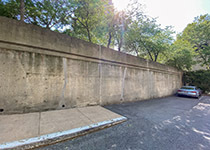
Most New York City property owners and managers are familiar with Local Law 11/98 (now called the Facade Inspection Safety Program, or FISP), which requires buildings taller than six stories to have their facades inspected for unsafe conditions every five years. Less well known is Local Law 37 of 2008, which requires owners with retaining walls 10 feet or taller that front a public right of way to have those walls inspected by a design professional every five years to ensure they are maintained in a safe condition.
Under Local Law 37/08, owners must file an inspection report with the Department of Buildings classifying the wall as safe, unsafe, or safe with repair and/or engineering monitoring. Property owners with unsafe retaining walls, such as your cooperative, are issued an ECB violation and may face fines of up to $1,200.
Why Retaining Walls Deteriorate Over Time
Constant Exposure
Retaining walls are constantly exposed to soil and moisture, and the same freeze/thaw cycle that causes masonry on a facade to crack, spall, loosen, and eventually fall also afflicts retaining walls. Cracks allow more water to penetrate the wall, creating additional cracks and causing the wall to bulge, shift, and potentially collapse.
Vegetation is a particular problem for retaining walls. Not only does plant growth draw moisture to the wall, which can corrode underlying supporting steel, it displaces masonry and concrete as it grows, causes cracking. In addition, when the vegetation dies and decomposes, it creates a void in the wall, allowing more water to enter.
Construction
Retaining walls are typically made of concrete, masonry, or sometimes wood. The taller the wall, the more load it must support, and therefore the thicker the wall and footing must be. For every foot in height, about 30 to 50 pounds of pressure per square foot is exerted on the wall. A 15-foot wall, such as the one at your cooperative, has anywhere from 450 to 750 pounds of lateral soil pressure per square foot at the base of the wall and even more with saturated soil. The potential for instability and collapse is therefore greater with a taller retaining wall that has not been properly maintained.
A common problem with retaining walls, especially older ones, is that many were constructed as makeshift structures and were not designed by a professional engineer. For example, walls built by patching together dissimilar materials—such as concrete and stone—are not as strong or cohesive as walls constructed from a uniform material and tend to crack where the different materials are joined.
Poor construction can cause damage in other ways. Makeshift walls typically do not have control joints to allow the concrete or masonry to expand and shrink. Without control joints to relieve stress, cracks typically form in the wall approximately 15 feet apart—where the control joints should have been.
Drainage
A retaining wall should have weep vents for proper drainage and control joints to relieve stress.
A properly designed retaining wall should have weep vents spaced approximately four feet on center so water can freely drain from behind the wall. The weep vents should be lined with PVC or another durable material, not stone or masonry, which can wear away and allow water to enter the wall. Poor drainage will cause water to build up in the soil behind the wall, exerting more pressure on it. The extra weight from a heavy rain, for example, could more than double the load on a wall with inadequate drainage.
Water seeping through a retaining wall even when it hasn’t been raining could be an indication of a broken underground pipe behind the wall. To try to pinpoint the source of the leak, the water can be tested for chlorine—a positive test points to a leak in a domestic water system. Adding a nontoxic dye to the building’s hot water tank or boiler can also help trace the leak source.
Soil
Also critical to the stability of a retaining wall is the soil in which it is embedded. To assure the soil has adequate bearing pressure to stabilize the wall, a wall’s footings must be embedded below the minimum frost depth required by law, which in New York City is four feet. Building the footing at this depth mitigates the risk of damage due to frost heave, which occurs when water in the soil freezes and expands, causing the wall to shift. Before a new wall is constructed, the soil must be tested to determine its bearing capacity.
Load Change
Retaining walls can shift and even collapse over time because of the additional loads imposed when use of the adjacent space changes. For example, if the area behind a wall is converted from a grassy area to a parking lot or a building, additional lateral loads will be imposed on the wall, which the wall may not have been designed to support. Whenever a change in use is planned for an area adjacent to a retaining wall, an engineer should evaluate the potential new loads to determine the effect they will have on the existing wall.
Rails and Fences
New York City Building Code requires fall protection for any wall with more than a 30-inch drop between the top of the wall and the ground. Although technically not part of the retaining wall, rails and fences installed on top must be maintained not only for obvious safety reasons, but also for the wall’s long-term stability.
Railings and fence posts must be properly embedded to provide proper structural support and to prevent water from draining into the wall. Even properly installed penetrations loosen over time, allowing water to enter the concrete, so all penetrations should be regularly checked for stability and a proper seal.
Repair and Replacement
If the deterioration of a retaining wall is limited to a few locations and the overall stability of the wall has not been compromised, it may be possible to repair the damage by patching or replacing the masonry in those areas. However, if the retaining wall has extensive damage, or the wall has severely shifted, bulged, or partially collapsed, then replacement of that section—and possibly the entire wall—may be required.
Replacing a retaining wall is a major undertaking. It is usually done by removing and replacing small sections at a time in a carefully sequenced manner to prevent the existing wall from collapsing. Temporary shoring may be required, such as embedding soldier piles and lagging behind the wall to hold the soil in place. The areas adjacent to the retaining wall—in your co-op’s case, the parking lot—will need to be kept clear during the repair program.
Buttressing
In some cases where the damage is not too severe, installing permanent buttresses along the wall may be an option. Buttresses are typically rectangular projections at the front of the wall designed to brace it against lateral loads. The size and spacing of buttresses is determined by a structural analysis. Buttresses are generally built to match the original wall construction as much as possible, but they can be modified to accommodate an owner’s aesthetic preferences. Buttressing can be a good choice if the wall cannot be replaced or the work cannot be done behind the existing wall.
Segmental Retaining Walls
Another option for replacing a retaining wall involves using pre-cast concrete segments (typically with replicated masonry finishes) stacked in a staggered fashion and held together by pins, without mortared joints. A geo-textile fabric placed behind the wall stabilizes the soil, thereby reducing lateral loads on the wall. Because segmental retaining walls are not held together by mortar, they have a built-in flexibility that allows them to accommodate small displacements without cracking, and they do not require footings to be built below frost depth. Costs for segmental retaining walls can be competitive with comparable masonry or concrete walls.
Violations
Although the DOB has issued your co-op an ECB violation, they don’t expect a failed retaining wall to be repaired overnight. They do want to see, however, that the building owner is taking steps to properly address the situation. The DOB will require that all necessary emergency safety and protection measures be put in place, such as temporary bracing to prevent collapse. An evaluation report from an engineer that describes the condition of the wall, explains the cause of any failure, and recommends a repair/replacement plan will usually buy the owner more time to pursue the proper repair program.
Ongoing Maintenance
Retaining walls must be monitored as part of a regular maintenance plan.
Like the exterior wall of a building, retaining walls must also be monitored as part of a regular maintenance plan. Building staff should regularly monitor the condition of the wall, looking for deteriorated mortar joints, cracks, bulges, shifting, crumbling, and/or any changes in the landscape on either side of the wall. Drainage vents must be kept clear, and the staff needs to take particular note of any water pooling at the base of the wall, which could weaken the foundation. Fences and railings should be checked for stability, and penetrations properly caulked and/or sealed to prevent water infiltration.
Although retaining walls are often out of sight, they shouldn’t be out of mind for building owners and managers. Addressing small problems as they crop up will prevent major problems and expenses down the line.
This column was originally published in the September 2013 issue of Habitat Magazine.