
Local Law 97 Compliance Guide
New York City’s Local Law 97 is now in active enforcement, requiring most covered buildings over 25,000 square feet to meet greenhouse gas emissions limits and submit annual compliance reports.
For building owners and managers, the stakes are significant. Failure to file can result in substantial monthly penalties, while buildings that exceed their emissions limits may face annual fines based on the amount of excess emissions. At the same time, the stricter emissions limits taking effect in 2030 will bring many more buildings into noncompliance if they do not begin planning ahead.
Understanding how Local Law 97 applies to your building, which compliance pathway applies, and what steps may be needed before 2030 is critical to managing risk and making informed capital planning decisions.
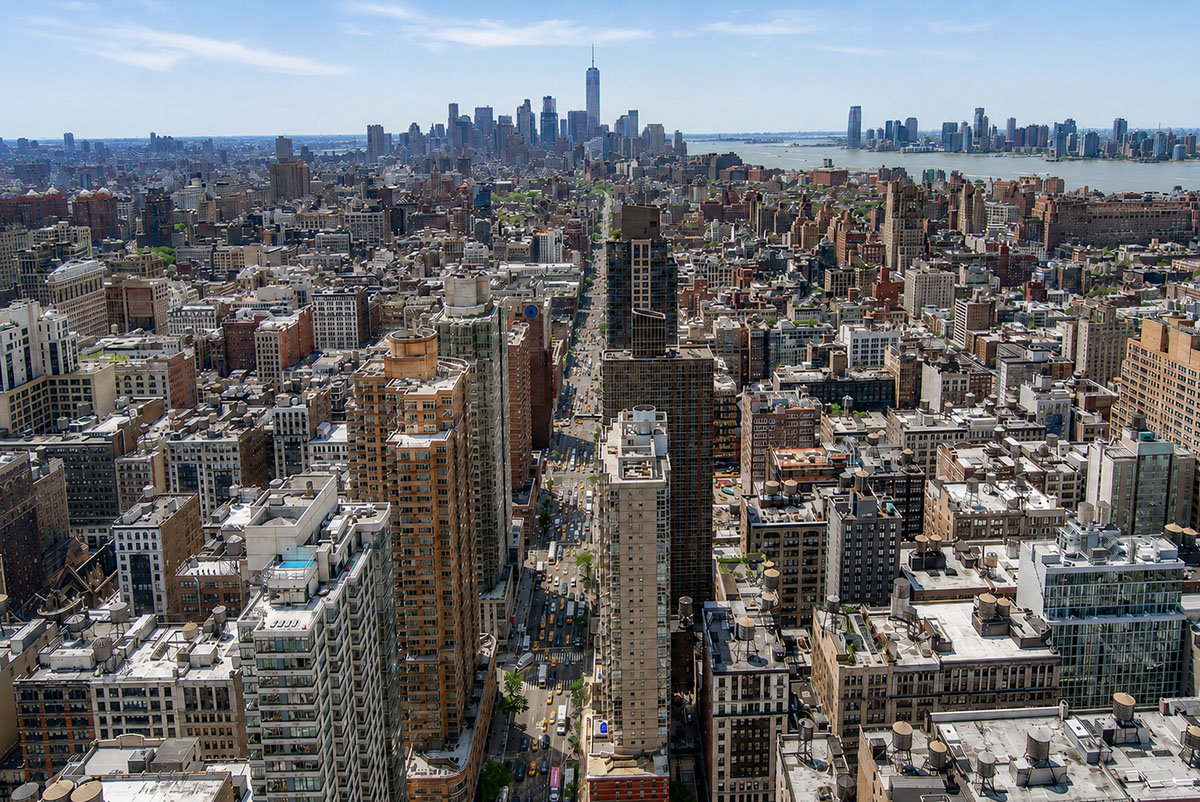
Local Law 97 aims to reduce greenhouse gas emissions from New York City’s largest buildings 40% by 2030 and achieve net zero emissions by 2050.
What is Local Law 97 of 2019?
Background
In 2019, the New York City Council passed a series of laws, together known as the Climate Mobilization Act (CMA), designed to meet New York City’s commitment to align with the Paris Agreement, an effort to mitigate the risks and effects of climate change by limiting the increase in global average temperature to 1.5°C and achieve net zero emissions by 2050.
Local Law 97 of 2019, the centerpiece of the legislative package, aims to reduce greenhouse gas emissions from New York City’s largest buildings 40% by 2030 and achieve net zero emissions by 2050. The law sets increasingly stringent emissions limits for large residential and commercial buildings and is implemented through Articles 320 and 321 of the NYC Administrative Code, which establish requirements for emissions limits, calculations, penalties, and compliance reporting.
Which Buildings Are Subject to Local Law 97?
Local law 97 generally applies to:
- Buildings over 25,000 gross square feet
- Two or more buildings on the same tax lot that together exceed 50,000 gross square feet
- Two or more condominium buildings governed by the same board of managers that together exceed 50,000 gross square feet
Different covered buildings may be subject to different Local Law 97 compliance requirements under Article 320 or Article 321 of the NYC Administrative Code, depending on factors such as building type, use, and regulatory status.
For more information and the Covered Buildings List (CBL), see the NYC Department of Buildings’ Local Law 97 guidance: https://www.nyc.gov/site/buildings/codes/ll97-greenhouse-gas-emissions-reductions.page
What Is the Difference Between Local Law 97 Article 320 and Article 321?
Article 320 and Article 321 establish different Local Law 97 compliance requirements for different types of covered buildings.
Article 320 applies to most covered buildings and requires compliance with annual greenhouse gas emissions limits. Most Article 320 buildings must file an annual emissions report with the NYC Department of Buildings.
Article 321 applies primarily to certain affordable housing buildings and houses of worship. These buildings were required to comply through either prescribed energy conservation measures or a performance-based pathway tied to the 2030 emissions limits.
How Can Owners Comply?
Emissions Limits
The City’s goal of reaching carbon neutrality (net zero carbon emissions) by 2050 is an ambitious one, and the established emissions reduction targets are accordingly aggressive. Local Law 97/19 sets emissions intensity limits (defined in units of tCO2e/sf, or metric tons of carbon dioxide equivalent per square foot) based on building code occupancy groups. For mixed-use buildings, the emissions limits are calculated using a weighted average of the different occupancy types within the building, with limits determined separately for each use type before being combined into an overall target.
There are two initial compliance periods from 2024-2029 and 2030-2034, with future compliance requirements through 2050 to be determined by the City. The emissions intensity limits become more stringent each compliance period, so building owners must take steps to reduce their building’s carbon emissions over time to comply with the law.
What Changes Under Local Law 97 in 2030?
The emissions limits become significantly more stringent beginning in 2030. A building that complies with the 2024-2029 limits may still exceed its allowable emissions under the 2030-2034 limits.
Owners planning heating system replacements, major capital projects, or other building upgrades should consider the 2030 limits when making long-term investment decisions. Evaluating projected performance now can help identify potential compliance gaps and opportunities to coordinate emissions-reduction work with planned capital improvements.
Options for Compliance
Along with implementing energy-efficiency and emissions-reduction measures, eligible buildings may be able to reduce their reported annual emissions through certain deductions permitted under Local Law 97, including:
- Purchasing eligible renewable energy credits (RECs). RECs may only be used to reduce emissions attributed to utility-supplied electricity and cannot offset on-site fossil fuel emissions.
- Purchasing qualifying greenhouse gas offsets
- Generating or storing qualifying clean distributed energy resources
Annual Reporting
Local Law 97 requires covered buildings to submit an annual greenhouse gas emissions report through DOB NOW: BEAM, certified by a Registered Design Professional (RDP).
The filing deadline is May 1 each year, covering emissions from the previous calendar year, with an automatic 60-day grace period through June 30.
Each report must confirm whether the building complied with its emissions limit and, if applicable, identify the amount by which it exceeded that limit.
Most buildings are subject to this annual filing under Article 320 of the Administrative Code. However, buildings with certain percentages of rent-regulated units or those qualifying under Article 321 may follow alternative compliance schedules or reporting pathways.
Filing Extensions
Building owners who requested an extension through DOB’s BEAM portal by June 30, 2026, may file their 2025 emissions report by August 29, 2026. The extension is not automatic and is not available to buildings that did not submit a request by the June 30 deadline.
What is Gross Floor Area (GFA) Verification?
Accurate Gross Floor Area (GFA) measurement is essential for filing emissions reports under Local Law 97, as it serves as the basis for calculating a building’s carbon emissions limits and determining compliance. GFA differs from the Gross Square Footage (GSF) figures provided by the Department of Finance or used in past LL84 benchmarking filings. Outdated or incorrect GSF figures can result in reporting delays or non-compliance.
For compliance:
- Calculations must adhere to specific criteria outlined in Local Law 97.
- Buildings with multiple occupancy groups or property types require detailed GFA breakdowns by use type to calculate weighted emissions targets.
- Gross floor area must be verified by a Registered Design Professional using appropriate supporting documentation.
What Are the Local Law 97 Penalties for Noncompliance?
Building owners that fail to comply with Local Law 97 may face significant civil penalties.
For buildings subject to Article 320:
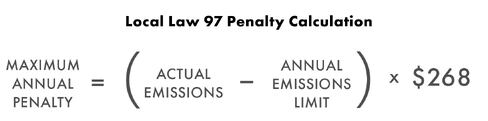
- Exceeding the annual emissions limit: $268 for each metric ton of carbon dioxide equivalent above the building’s applicable emissions limit.
- Failure to file the annual emissions report: $0.50 per gross square foot for each month the violation remains uncorrected.
- Knowingly making a material false statement: A fine of up to $500,000, imprisonment for up to 30 days, or both, as well as a civil penalty of up to $500,000.
Buildings subject to Article 321 have separate penalties, including $10,000 for failure to submit the required compliance report and $10,000 for failure to demonstrate compliance.
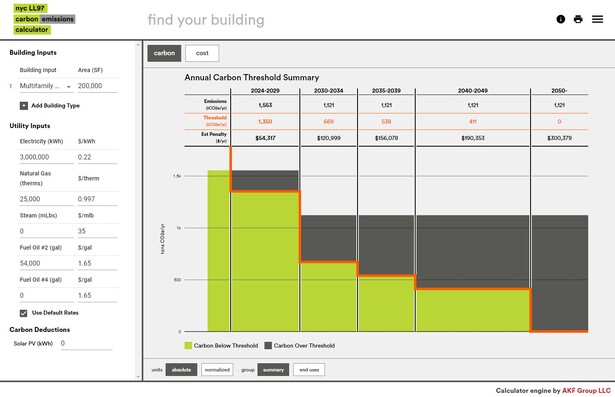
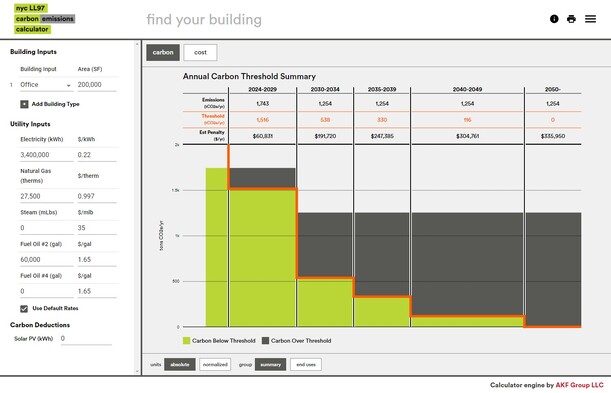
Building Energy Exchange offers a useful LL97 Carbon Emissions Calculator that can generate carbon thresholds, potential penalties, and utility cost metrics across each compliance period for building owners to assess their compliance status.
For a 200,000-square-foot residential building and the same sized office building that exceeds 15% of its allowable emissions, the annual fines are substantial and will be ratcheted up each compliance period. Examples below.
Is Financial Support Available?
Many tax credits, grants, and green funding incentives are available at the federal, state, and local levels to assist in financing energy conservation measures for Local Law 97 compliance. Property Assessed Clean Energy (PACE) program for New York City which provides long-term and low-interest loans to finance energy improvements and retrofits that will help building owners meet the upcoming emissions requirements. Fannie Mae and Freddie Mac also offer green financing programs.
PACE Financing
NYC’s Commercial Property Assessed Clean Energy (C-PACE) program provides long-term, fixed-rate financing that can cover up to 100% of eligible energy efficiency and renewable energy project costs, with no upfront cash payment required from the owner.
NYCEEC Loans
Cooperatives and condominiums interested in financing clean energy installations and upgrades, such as HVAC systems, solar panels, electrification and heat pumps, and fuel conversion, may be eligible for the following New York City Energy Efficiency Corporation (NYCEEC) loans. Eligible project costs can be financed by NYCEEC up to 90%, and for affordable multifamily buildings, up to 100% of such costs may be financed:
Incentives from NY State and Utility Companies
Certain cooperatives, condominiums, and multifamily buildings may be eligible for credits or cash rebates through specific programs such as:
- Clean Heating Fuel Credit
- Con Edison Multifamily Energy Efficiency Program
- Con Edison Multifamily Buildings Neighborhood Program (Brooklyn and Queens only)
- Con Edison New York State Affordable Multifamily Energy Efficiency Program
A comprehensive list of financial incentives, tax credits, and financing options can be found on the DOB’s website: https://bit.ly/DOB-LL97-incentives
Local Laws 84 and 87 of 2009 form the foundation for NYC’s sustainability initiatives:
- Benchmarking Law (LL84): Require annual energy benchmarking for buildings over 25,000 square feet. Non-compliance results in fines of $500 per quarter, up to $2,000 annually.
- Energy Audits & Retro-commissioning (LL87): Mandates energy audits and retro-commissioning every ten years for buildings over 50,000 square feet, with penalties starting at $3,000 for late filings.
These laws currently remain separate from Local Law 97 but complement its emissions reduction goals.
Ways to Reduce Carbon Emissions
Implementing the following measures can help building owners reduce their carbon emissions:
- Choose a professional with expertise in local law compliance.
- Conduct an energy audit to identify areas of inefficiency and develop an energy-saving plan.
- Perform energy and water benchmarking annually.
- Install energy-efficient lighting and HVAC systems.
- Perform regular maintenance of HVAC equipment.
- Use occupancy sensors and timers to control lighting and HVAC systems.
- Improve insulation and air sealing to reduce heating and cooling losses.
- Implement water-saving measures to reduce water consumption and associated energy usage.
- Install renewable energy systems such as solar panels or wind turbines to generate clean energy.
- Encourage tenants to adopt sustainable behaviors, such as reducing waste and recycling, and using natural lighting to reduce the use of artificial light.
Recommendations for Moving Forward
Compliance requires a combination of mandatory reporting and long-term emissions reduction planning. At RAND, we offer a systematic approach to help your building address immediate compliance requirements and long-term sustainability goals:
Mandatory Filing Assistance
Our team collaborates with building owners and managers to prepare and submit required documentation, including:
- Verified Gross Floor Area (GFA) calculations.
- Floor plans and stacking diagrams attested to by a RDP.
- Benchmarking data to confirm compliance with emissions limits.
Energy Analysis
We review and analyze a building’s energy bills to establish a baseline for energy use and emissions, providing valuable insights for identifying improvement opportunities.
Comprehensive Energy Audit
For buildings exceeding emissions limits or seeking energy efficiency improvements, we identify practical, cost-effective energy-saving measures tailored to the specific needs of a building.
Roadmap Development
We create a phased plan to help buildings meet emissions targets for 2024, 2030, and beyond. This includes:
- Specific energy conservation recommendations.
- Preliminary cost estimates for upgrades and retrofits.
- A timeline for implementation to meet compliance deadlines and reduce long-term costs.
RAND’s Expertise & Partnerships
RAND is a NYSERDA Multifamily Building Solutions Network (MFBSN) Provider and a NYC Accelerator Service Provider. Through these partnerships, we offer expertise to help buildings access funding, technical resources, and strategic support to achieve energy goals and comply with Local Law 97.
Further Reading
Read the full text of the law:
- Local Law 97: http://bit.ly/locallaw97
- Local Law 147 of 2019: https://www.nyc.gov/assets/buildings/local_laws/ll147of2019.pdf
- DOB Rule 103-14: https://www.nyc.gov/assets/buildings/rules/1_RCNY_103-14_prom_details_date.pdf
- Article 320: https://bit.ly/LL97-Article320
- Article 321: https://bit.ly/LL97-Article321
Contact RAND
RAND’s MEP & Energy Team specializes in helping building owners comply with Local Law 97. RAND works with owners to develop energy and greenhouse gas reduction strategies, identify practical energy-saving measures, and create a roadmap to achieve emissions reductions in line with Local Law 97. Our comprehensive approach balances legal compliance, building performance optimization, and resident and tenant comfort, while efficiently managing operational costs. By providing tailored strategies and recommendations, we support long-term sustainability and improved living environments. For more information on how RAND can support your compliance efforts, contact RAND at 212-675-8844 or info@randpc.com.